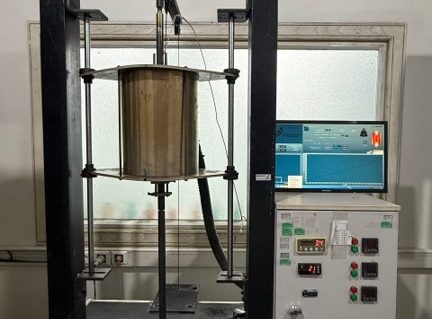


Creep & Stress Rupture Test
The creep test is conducted to evaluate the long-term deformation behavior of materials subjected to constant load at elevated temperatures. It determines creep rate, the different creep stages (primary, secondary, and tertiary), time to rupture, and rupture strength. Testing is performed at controlled temperatures up to 1100 °C, and the system provides continuous graphical output in the form of strain–time curves for analyzing creep behavior and predicting material lifetime in high-temperature, load-bearing applications.
The stress rupture test evaluates the time-dependent fracture behavior of materials under constant tensile load at elevated temperatures. A uniaxial stress is applied and maintained at a specified temperature until rupture occurs, allowing determination of the time to rupture under defined stress–temperature conditions. This test is essential for material selection, component design, and life assessment of high-temperature equipment such as boiler tubes, steam headers, pressure vessels, and turbine components, and is widely used in power generation, petrochemical, and oil & gas industries
Standard: ASTM E139