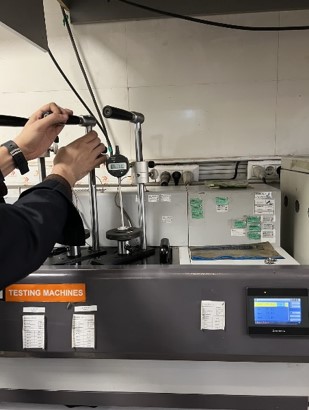


Thermogravimetric Analysis (TGA) Test
Purpose: Determination of weight changes in polymers upon heating to evaluate thermal stability, decomposition temperature, and the content of additives and fillers.
Standards: ASTM E1131, ASTM D3850, ISO 11358-1 & 2, DIN 51006
Measured Properties
- Weight Loss / Mass Change:
Quantification of the sample’s mass reduction or gain under heating or controlled conditions.
Units: % or g - Onset Decomposition Temperature (Tonset):
Temperature at which the sample begins thermal decomposition or noticeable mass loss.
Units: °C - Peak Decomposition Temperature / Tmax:
Temperature corresponding to the maximum rate of mass loss during decomposition.
Units: °C - Stepwise Decomposition / Multi-step Decomposition:
Identification of successive thermal degradation stages of the polymer matrix, additives, or fillers. - Residue / Char Content:
Mass remaining after complete thermal decomposition, typically used to evaluate mineral content, fillers, or residual carbon. - Rate of Mass Loss / dm/dt:
Derived from the DTG (Derivative Thermogravimetry) curve, providing detailed
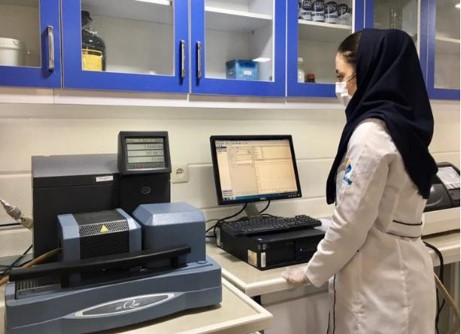
Plastics – Differential scanning calorimetry (DSC)
Purpose: Differential scanning calorimetry (DSC) methods are used for the thermal analysis of polymers and polymer blends.
Standards: ASTM D3418, ISO 11357
Measured Properties
Differential scanning calorimetry (DSC) methods are used for the thermal analysis of polymers and polymer blends, such as:
- Thermoplastics (polymers, molding compounds and other molding materials, with or without fillers, fibers or reinforcements),
- Thermosets (uncured or cured materials, with or without fillers, fibers or reinforcements), and
- Physical transitions (glass transition, phase transitions such as melting and crystallization,
• Polymorphic transitions, etc.), - Chemical reactions (polymerization, crosslinking and curing of elastomers and thermosets, etc.),
- The stability to oxidation, and
- The heat capacity
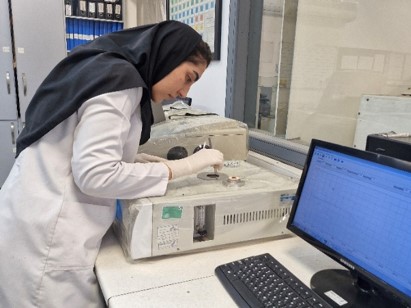
Plastics – Thermoplastic materials – Determination of Vicat softening temperature (VST)
Purpose: The determination of the Vicat softening temperature (VST) of thermoplastic materials:
- Method A50 using a force of 10 N and a heating rate of 50 °C/h
• Method B50 using a force of 50 N and a heating rate of 50 °C/h
• Method A120 using a force of 10 N and a heating rate of 120 °C/h
• Method B120 using a force of 50 N and a heating rate of 120 °C/h
Standards: ASTM D1525, ISO 306
Measured Properties
- Determination of the Vicat softening temperature (VST) of thermoplastic materials
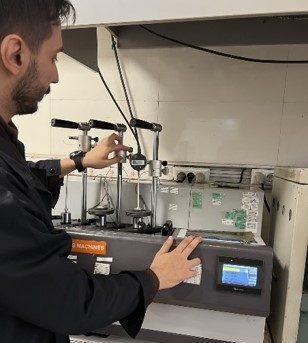
Plastics – Determination of temperature of deflection under load (HDT Test)
Purpose: The determination of the temperature of deflection under load (flexural stress under three-point loading) of plastics. Different types of test specimen and different constant loads are defined to suit different types of material.
Standards: ASTM D648, ISO 75-1 & 2 & 3
Measured Properties
determination of the temperature of deflection under load (flexural stress under three-point loading)of plastics